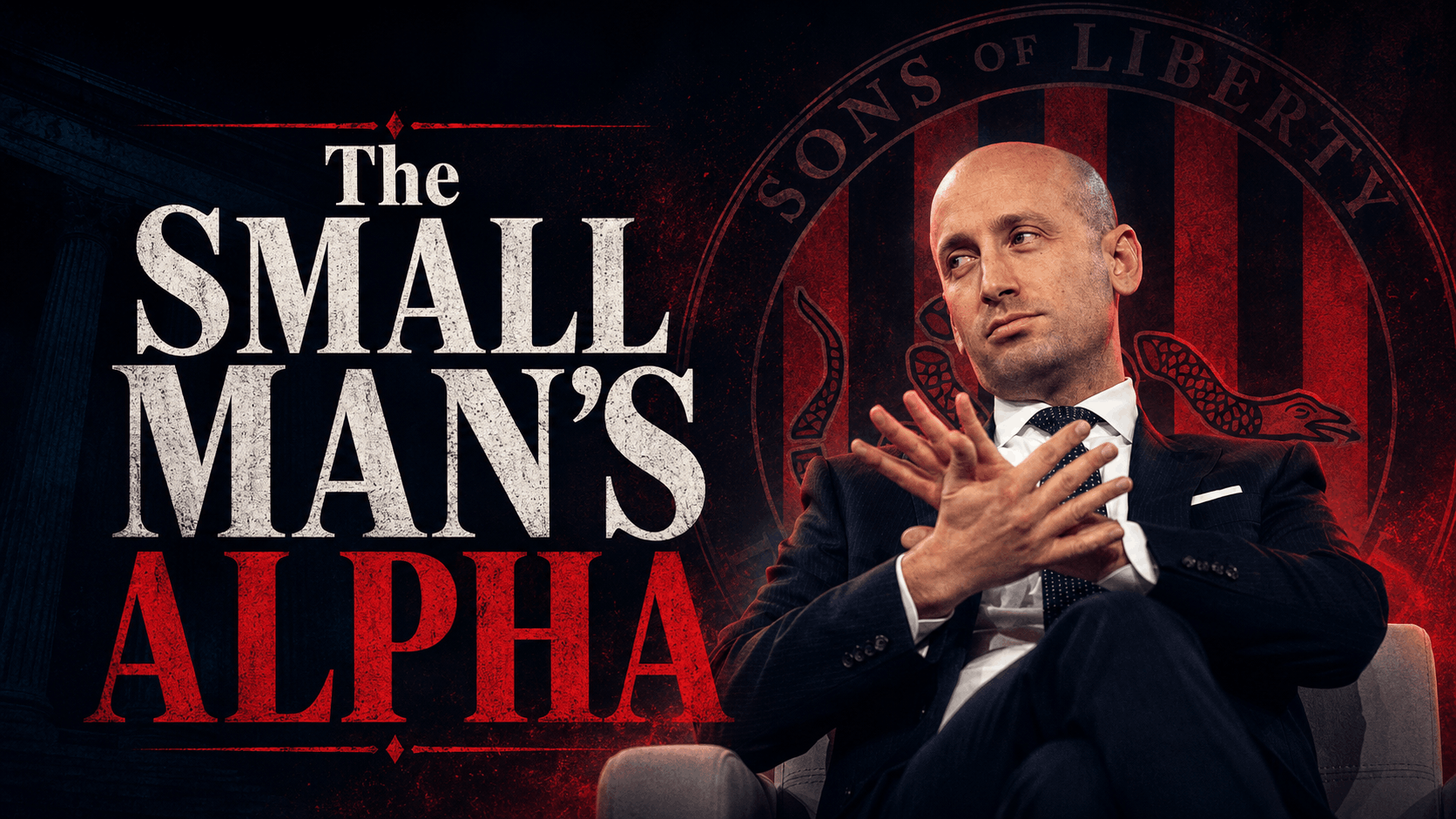
The Small Man’s Alpha:
Stephen Miller and the Politics of Looking Down
There is nothing strong about needing a vulnerable group beneath your boot so you can feel tall.
Stephen Miller has made a career out of selling a very old product in a louder box: the promise that somebody else’s misery will make you safer, richer, or more important.
After the Supreme Court handed the administration major immigration wins this week, Miller announced that “America’s doors are closed fully to asylum seekers.” He did not say it with the weight of a difficult duty, or the sober language of a country trying to balance law, security, and human life. He said it like a man celebrating the closing of a gate.
That tells you something.
There are real immigration questions. A country has a right to secure its borders, enforce its laws, and insist that its government know who is entering. That is not controversial. It does not require cruelty, chest-thumping, or turning frightened families into a prop for somebody else’s political manhood.
“A man who needs a weaker person to feel powerful is not powerful. He is simply insecure with an audience.”— Blue Pill Masculinity
A line often attributed to Lyndon Johnson captures the trick. It was later recalled by Bill Moyers: convince a poor white man that he outranks a Black man, and he will not notice that somebody is picking his pocket. Give him someone to look down on, and he will hand over what he has left.
That is not ancient history. It is a field manual for modern grievance politics.
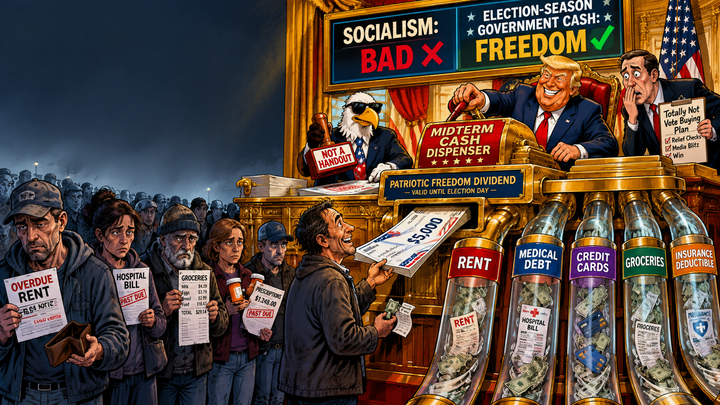
When your rent is high, your wages do not stretch, your health care costs are absurd, and your kid cannot get a decent start without borrowing against the future, it is useful for powerful people to give you a target. Not the private-equity firm buying up housing. Not the employer fighting your raise. Not the donor class collecting tax breaks in the dark. No. Look down. Blame the migrant. Blame the refugee. Blame the family with less protection than you.
It is an efficient con because it turns economic anxiety into moral permission. It also flatters the customer. You may not have more money, security, or political power. But you are told you have a group beneath you. For some men, that cheap little thrill is enough to buy the whole lie.
The internet has squeezed the word alpha until it barely means anything. Usually it means a man posing beside an expensive truck, speaking in commands, and treating basic decency as evidence of weakness. Fine. Let us use the term anyway, but use it correctly.
A real leader does not need a scapegoat. He does not need women diminished, immigrants humiliated, or minorities frightened so he can feel like the big dog in the room. He can defend a boundary without enjoying another human being’s fear. He can make a hard call without turning cruelty into a personality.
- He protects people who are in his care.
- He separates discipline from humiliation.
- He does not confuse volume with authority.
- He refuses to let resentment do his thinking for him.
- He does not demand applause for meeting the minimum standard of human decency.
Any halfway competent NCO understands the difference. You can secure a perimeter without abusing the people at the gate. You can enforce a standard without making a spectacle of somebody’s pain. You can be firm without becoming small.
Watch how a man treats people who cannot do anything for him. That is usually where the costume falls apart.
Miller’s political style is the antithesis of that kind of strength. It runs on permanent siege language, social contempt, and the convenient claim that compassion is weakness. The point is not simply policy. The point is posture: prove you are hard by being hard on people with less power than you.
That is not toughness. It is dominance theater.
It is also cowardly politics. The people at the top rarely pay the bill for it. The factory worker, the soldier’s spouse, the small-town employer who cannot fill a job, the kid whose neighbor is suddenly gone, the community forced to live with chaos and fear, those are the people asked to absorb the consequences. Meanwhile, the man at the microphone gets to perform certainty.
There is no courage in pointing at a vulnerable family and saying, “There. That is why your life is hard.” That is the oldest dodge in the book. It keeps the public staring down while the real predators walk past the cash register.
“Secure borders are compatible with a secure conscience. Cruelty is not a requirement of national strength.”— The line they do not want to cross
Blue Pill Masculinity does not ask men to become passive. It asks them to become harder to manipulate.
Have standards. Own a gun responsibly. Drive a truck. Drink a beer. Lift weights. Protect your family. Vote for border security if that is where your judgment lands. But do not hand your brain, your conscience, or your country over to men who need a permanent underclass to keep their own egos inflated.
America does not need softer borders or harder borders as a substitute for character. It needs adults who can tell the difference between enforcement and sadism, between patriotism and panic, between leadership and a man using weaker people as a stage prop.
Do Not Let Them Rent Space in Your Backbone.
Stephen Miller’s appeal depends on a bargain: accept someone else’s degradation, and you get to borrow the feeling of strength. It is a bad bargain. It will not make you more secure. It will not make you more masculine. It will not fix what powerful people have taken from working Americans for decades.
It will just make you easier to use.
A decent man does not need a population to push around. He has enough spine to stand up without standing on somebody else.
Source note: The post responds to recent reporting on Stephen Miller’s immigration comments after Supreme Court rulings. The Johnson quotation is presented carefully as a widely reported recollection by Bill Moyers, published in The Washington Post in 1988, not as a contemporaneous recording or official transcript.