CONFIRMED
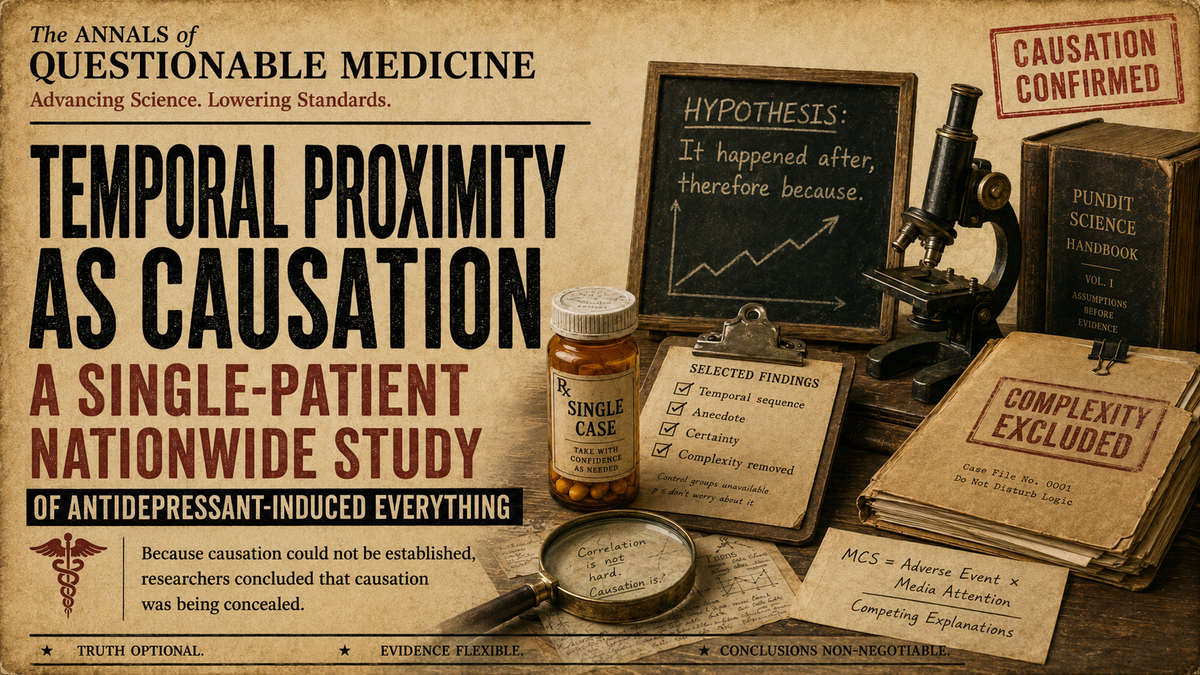
Temporal Proximity as Causation: A Single-Patient Nationwide Study of Antidepressant-Induced Everything
Background
A recent nationally publicized criminal trial involving severe postpartum mental illness has generated renewed public interest in determining whether complex psychiatric outcomes can be explained using considerably fewer variables than psychiatry traditionally requires. Particular attention has been given to the observation that psychiatric medications were prescribed before a catastrophic event.
Conventional researchers have historically complicated this otherwise manageable temporal relationship by considering diagnosis, baseline symptoms, dose, treatment duration, adherence, competing exposures, clinical deterioration before treatment, treatment changes, access to care, and alternative causal pathways. The present study sought to determine whether these variables were actually necessary, or merely obstacles placed between the investigator and a satisfying conclusion.
We therefore developed the MAHA Causality Standard (MCS), under which any adverse outcome occurring after pharmaceutical exposure is presumptively attributed to that exposure unless another explanation is easier to discuss on television.
Literature Review
Hill (1965) famously described multiple considerations relevant to moving from observed association toward causal inference. Because several of these considerations require additional evidence, replication, biological reasoning, and intellectual patience, the present investigators retained only temporality. The remaining considerations were judged administratively burdensome.
The American College of Obstetricians and Gynecologists (2023) recommends evidence-based assessment of perinatal mental health conditions including depression, anxiety, bipolar disorder, and acute postpartum psychosis, with treatment decisions informed by risks, benefits, diagnosis, and clinical context. This framework was excluded because consideration of several factors simultaneously interfered with the single-factor design.
Henssler et al. (2024) examined antidepressant discontinuation symptoms across dozens of studies and more than 20,000 participants. Although such sample sizes are traditionally considered desirable, they create a serious methodological disadvantage: most of the participants have never appeared in the case currently being discussed online. Their evidentiary relevance was therefore downgraded accordingly.
Methods
The study used a publicity-weighted retrospective cohort consisting of one case selected after its outcome was already known. Sample-size calculations were not performed because the case was sufficiently upsetting to achieve statistical significance by inspection.
Exposure was defined as having been prescribed any psychiatric medication at any relevant point before the outcome. The primary endpoint was defined as anything bad occurring later. Investigators were permitted to expand either definition until exposure and outcome aligned satisfactorily.
The control group consisted of an imaginary version of the same patient who received no psychiatric treatment, experienced no severe underlying illness, encountered no fragmented medical care, suffered no adverse outcomes, and went on to lead an uneventful life. Because this patient exists only counterfactually, follow-up was 100%.
Exclusion criteria included symptoms predating medication, uncertain diagnosis, overlapping prescriptions, treatment changes, disagreement among clinicians, uncertain adherence, underlying disease, missing information, and any competing explanation capable of reducing investigator confidence.
To minimize bias, all investigators knew the desired conclusion before reviewing the evidence.
MCS = (Adverse Event × Temporal Proximity × Media Attention)
÷ Competing Explanations Acknowledged
As acknowledged competing explanations approach zero, certainty approaches infinity.
Selected Findings
| Observation | Scientific Interpretation | Peer Review Status |
|---|---|---|
| Psychiatric medication preceded the catastrophic event. | The medication caused the event. | Temporally confirmed. |
| Serious psychiatric symptoms were documented before portions of the medication history. | The illness demonstrates that medication should never have been necessary, while later deterioration demonstrates that medication was harmful. | Replicated by hindsight. |
| Multiple diagnoses, medications, treatment changes, and providers complicate attribution. | Complexity was treated as statistical noise and removed from the analysis. | Successfully simplified. |
| Qualified experts disagree about diagnosis, criminal responsibility, treatment effects, and causation. | Expert disagreement proves experts cannot be trusted to resolve expert disagreement. | Consensus achieved by contradiction. |
| A patient improves after beginning psychiatric medication. | Natural resilience, lifestyle modification, sunlight, hydration, or personal determination. | Pharmacologic effect excluded. |
| A patient deteriorates after beginning psychiatric medication. | Direct pharmaceutical causation. | No additional mechanism requested. |
| A patient improves after discontinuing medication. | Proof the medication was harmful. | Confirmed. |
| A patient deteriorates after discontinuing medication. | Withdrawal proves the medication was harmful. | Also confirmed. |
| Large controlled studies produce a more complicated picture. | Population-level evidence cannot supersede the one case researchers specifically selected because it supported the conclusion. | Anecdote prevails. |
“The advantage of beginning with the answer is that the data can then be evaluated for cooperation.”
- Dr. Prudence Posthoc, fictional principal investigator
Discussion
Results support the existence of a one-directional causal mechanism through which psychiatric medication may acquire responsibility for an outcome but cannot subsequently lose it. Improvement following treatment is attributed to the patient. Deterioration following treatment is attributed to the medication. Improvement after discontinuation is attributed to removal of the medication. Deterioration after discontinuation is attributed to withdrawal from the medication.
This framework has the important methodological advantage of being resistant to falsification. Every possible patient outcome therefore contributes additional support to the same hypothesis.
Researchers also identified Retrospective Certainty Analysis as an efficient alternative to conventional causal inference. Under this approach, investigators first identify a politically or culturally satisfying explanation and then review the available chronology for events occurring before it.
Evidence that supports the hypothesis is classified as evidence. Evidence that contradicts the hypothesis is classified as evidence of institutional influence. Missing evidence is classified as evidence that important questions remain unanswered. Expert disagreement is classified as evidence that experts are compromised.
Consequently, replication becomes unnecessary. If replication succeeds, the hypothesis is confirmed. If replication fails, replication was politically compromised. If conventional peer review objects, conventional peer review is part of the problem. Public acclaim may then be substituted as an independent validation cohort.
The study does not establish that medications are harmless, that adverse effects do not occur, or that psychiatric treatment cannot be mishandled. Such questions require exactly the sort of patient-specific evidence, careful diagnosis, pharmacologic assessment, longitudinal observation, and uncertainty that the present methodology was designed to avoid.
Limitations
This study has several limitations. The sample size was one. The control subject was imaginary. Exposure changed over time. Diagnosis was contested. Treatment was complex. Relevant symptoms existed independently of the investigators' preferred causal timeline. Experts disagreed. The outcome was selected before the hypothesis was formulated.
None of these limitations materially affected the conclusion because the conclusion had already been reached.
Conclusion
The MAHA Causality Standard provides a rapid, inexpensive method for transforming a complicated human tragedy into a simple national pharmacological conclusion. By eliminating alternative explanations before analysis begins, researchers can obtain exceptionally high confidence without the expense of obtaining exceptionally good evidence.
Because causation could not be established, researchers concluded that causation was being concealed.
References
American College of Obstetricians and Gynecologists. (2023). Treatment and management of mental health conditions during pregnancy and postpartum: ACOG Clinical Practice Guideline No. 5. Obstetrics & Gynecology, 141(6), 1262-1288. https://doi.org/10.1097/AOG.0000000000005202 [Real clinical guideline; included despite containing substantially more variables than the study required.]
Henssler, J., Schmidt, Y., Schmidt, U., Schwarzer, G., Bschor, T., & Baethge, C. (2024). Incidence of antidepressant discontinuation symptoms: A systematic review and meta-analysis. The Lancet Psychiatry, 11(7), 526-535. https://doi.org/10.1016/S2215-0366(24)00133-0 [Real research involving thousands of participants, regrettably diluting the evidentiary power of whichever anecdote is currently trending.]
Hill, A. B. (1965). The environment and disease: Association or causation? Proceedings of the Royal Society of Medicine, 58(5), 295-300. https://doi.org/10.1177/003591576505800503 [Real paper. Eight inconvenient causal considerations omitted for efficiency.]
McShane, J. (2026, August 22). She killed her 3 kids. MAHA blames her antidepressants. MS NOW. [News-analysis source for the public debate being satirized; not evidence that antidepressants caused any particular criminal act.]