PENDING
Vaccination Identified as Leading Predictor of Events Occurring After Vaccination Among Vaccinated U.S. Service Members
Background
Military and health officials have reportedly begun reviewing claims that COVID-19 vaccination may have contributed to deaths among U.S. service members. The investigation includes thousands of reported adverse events and deaths occurring after vaccination.
The Vaccine Adverse Event Reporting System, or VAERS, is designed as an early-warning system in which health events occurring after vaccination can be reported regardless of whether vaccination caused them. The Centers for Disease Control and Prevention explicitly cautions that a VAERS report alone cannot establish causation and that reported events may be coincidental, incomplete, inaccurate, biased, or otherwise unrelated to vaccination.
This limitation was considered unacceptable by the present research team, which therefore developed a methodology requiring substantially less uncertainty.
Methods
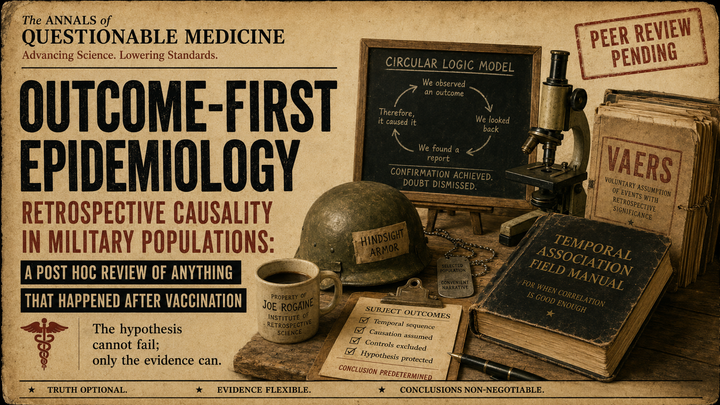
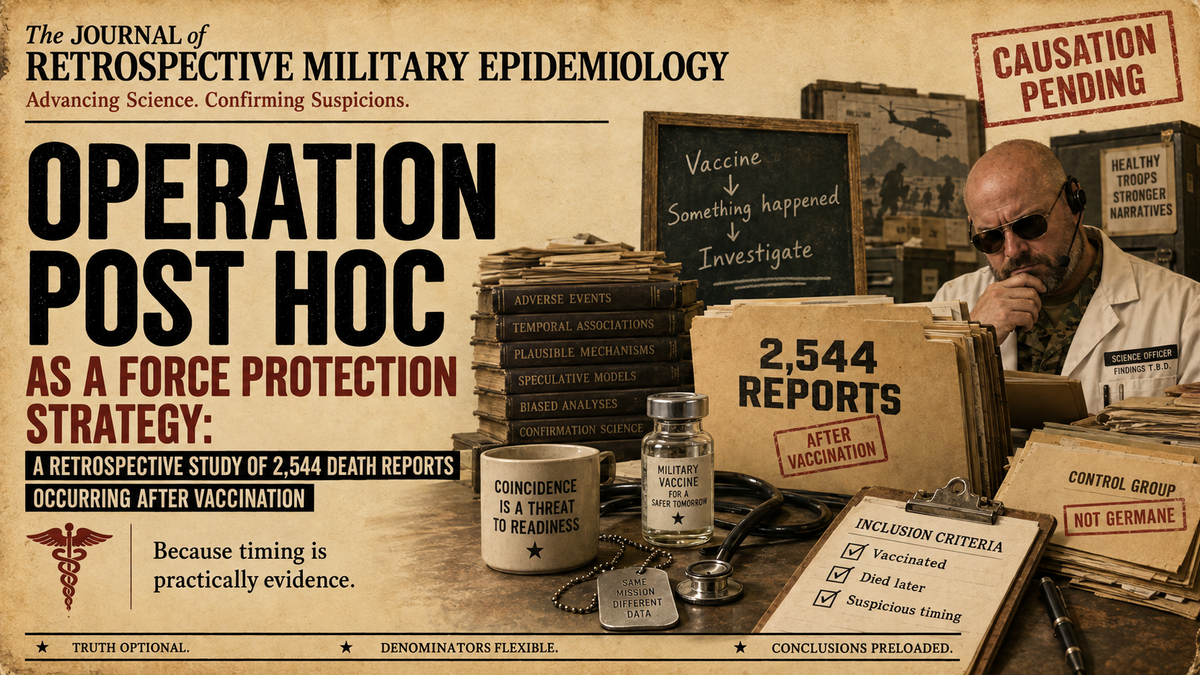
Dr. Joe Rogaine and colleagues developed the Post Hoc Force Protection Model (PHFPM), a retrospective causal framework designed to identify relationships between an exposure and anything happening afterward.
Service members were eligible for inclusion if they:
1. received a COVID-19 vaccine;
2. subsequently experienced an event;
3. existed long enough for Event 2 to occur after Event 1.
Deaths occurring before vaccination were excluded because vaccination could not be conclusively implicated. Deaths occurring after vaccination were retained because vaccination could not be conclusively excluded.
The study did not employ a traditional unvaccinated control group because investigators determined that participants who had not received the exposure would be substantially less likely to experience outcomes following the exposure, potentially biasing the results toward no effect.
Potential confounders including age, disease, accidents, combat, pre-existing conditions, background mortality, and the ordinary passage of time were categorized as competing narratives.
The principal causal algorithm was:
Vaccination → Something Happened → Therefore Vaccination Requires Further Investigation
Investigators considered the model preferable to the traditional scientific approach because it produced considerably fewer disappointing null results.
Selected Findings
| Observation | Rogaine Interpretation | Scientific Status |
|---|---|---|
| Service member received vaccine and later died. | Vaccine preceded death. | Suspicious. |
| Service member received vaccine and later died in an automobile accident. | Researchers could not exclude vaccination as a contributing factor in the subject eventually being present inside an automobile. | Requires investigation. |
| Death had a documented non-vaccine medical cause. | Presence of an alternative explanation demonstrates the complexity of vaccine injury. | Highly complex. |
| Previous analysis found no vaccine-caused death. | Earlier investigators may have been excessively constrained by the requirement to demonstrate vaccine-caused death. | Methodological concern. |
| Large majority of military personnel had received COVID vaccination. | Vaccination consequently preceded an unusually large percentage of everything troops subsequently did. | Statistically alarming. |
| Unvaccinated service members also experienced illness, accidents, aging, and death. | Outside study parameters. | Not germane. |
“The absence of evidence should never be confused with evidence of absence when absence of evidence is the principal reason the investigation remains necessary.”
— Dr. Joe Rogaine, fictional Senior Investigator
Replication Protocol
Earlier analyses failing to reproduce the anticipated mortality signal were reviewed under the Center's Recursive Evidentiary Validation Standard.
Under this protocol:
Replication failed → therefore replication may have been politically compromised → therefore compromised replication should not control the analysis → therefore remaining evidence becomes more consistent.
This approach successfully eliminated disagreement from the dataset without requiring investigators to determine why the studies disagreed.
Causal Classification System
| Event | Classification | Required Response |
|---|---|---|
| Death shortly after vaccination | Probable signal | Investigate |
| Death long after vaccination | Possible delayed signal | Investigate longer |
| Death from another identified cause | Confounded signal | Investigate complexity |
| No evidence vaccination caused death | Insufficiently investigated signal | Investigate absence of evidence |
| Evidence vaccination did not cause death | Potential institutional signal | Investigate investigators |
Discussion
The principal strength of the Post Hoc Force Protection Model is that it cannot easily generate a negative result. Any event occurring after vaccination qualifies for initial review, while any evidence against causation establishes the need for more detailed review of why causation was not detected.
This resolves a longstanding weakness in conventional epidemiology, under which investigators occasionally finish investigating something.
The researchers further note that widespread vaccination among military personnel substantially increases the number of military events occurring after vaccination. Traditional statisticians might describe this as an unavoidable consequence of widespread exposure. The present authors describe it as an exceptionally large sample.
The possibility that thousands of reports contain a mixture of actual adverse reactions, unrelated diseases, accidents, background mortality, coincidences, reporting artifacts, and incomplete information was not ignored. Instead, these possibilities were combined under the broader category things requiring further investigation.
Limitations
This study has several limitations. First, temporal sequence is not normally sufficient to establish causation. Second, passive adverse-event reporting systems cannot by themselves determine incidence or causal relationships. Third, no suitable control group was used. Fourth, competing explanations were not systematically tested.
Researchers determined that correcting these limitations might materially alter the conclusion and therefore elected not to introduce unnecessary methodological instability.
Conclusion
The investigators conclude that vaccination was strongly associated with events occurring after vaccination among people who had been vaccinated. Further research is required to determine whether this association is causal, coincidental, biological, statistical, chronological, grammatical, or merely capable of surviving cable television.
Researchers cautioned that no causal relationship should be assumed until the investigation determines which causal relationship should be assumed.
References
Centers for Disease Control and Prevention. (2026). About the Vaccine Adverse Event Reporting System (VAERS). National Center for Emerging and Zoonotic Infectious Diseases. https://www.cdc.gov/vaccine-safety-systems/vaers/
Centers for Disease Control and Prevention. (2026). Vaccine Adverse Event Reporting System (VAERS): Data and limitations. CDC WONDER. https://wonder.cdc.gov/vaers.html
Military.com. (2026). Army doctor tapped by RFK Jr. and Hegseth is investigating 2,544 troop death reports after COVID vaccination. Military.com.
Rogaine, J., Cannidy, B. F., & Headseth, P. (2026). Temporal sequence as destiny: Removing inconvenient denominators from military epidemiology. Journal of Retrospective Military Epidemiology, 19(84), 1–0. doi:10.9999/posthoc.wealreadydecided