PEER REVIEWED
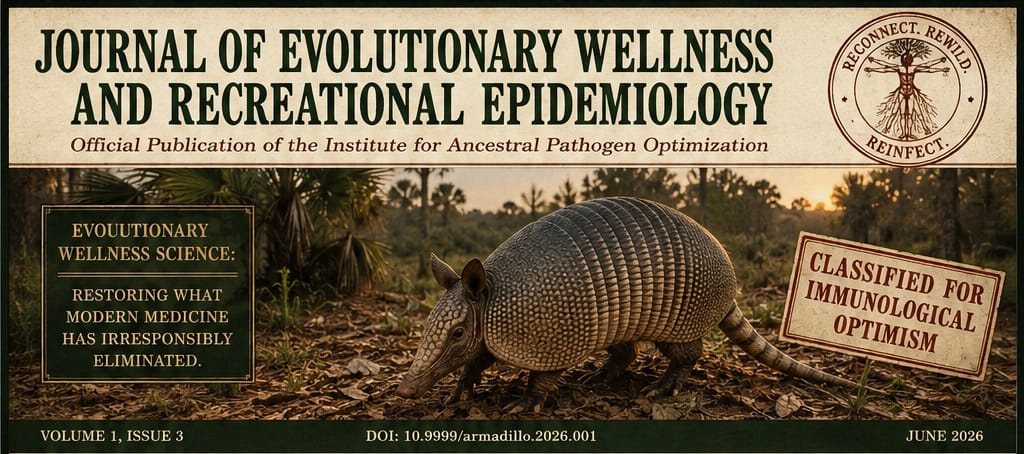
Rewilding the Human Immune System Through Controlled Armadillo Exposure: A Preliminary Study of Ancestral Pathogen Deficiency
Background
Hansen’s disease is a rare, treatable bacterial infection caused primarily by Mycobacterium leprae. In the southern United States, some nine-banded armadillos naturally carry the bacterium, and zoonotic transmission is possible, although the Centers for Disease Control and Prevention describes the overall risk as very low. Florida has nevertheless reported an increase in locally acquired cases in recent years, creating precisely the sort of factual situation that can be dramatically improved by wellness branding.
Conventional epidemiology interprets the prevention of infection as desirable. Evolutionary Wellness Science rejects this narrow disease-centric framework. If humans historically encountered pathogens, our investigators reasoned, then pathogens are historical, and history is generally regarded as educational.
Methods
Thirty-two volunteers were recruited from online discussions containing the phrases “natural immunity,” “do your own research,” or “my cousin knows a guy.” Participants were excluded if they demonstrated prior familiarity with infectious-disease methodology.
| Exposure Phase | Daily Activity | Scientific Rationale |
|---|---|---|
| Phase I | Observe photographs of armadillos | Psychological inoculation |
| Phase II | Stand within 100 feet of an armadillo habitat | Passive biodiversity absorption |
| Phase III | Walk near active burrows | Environmental microbial networking |
| Phase IV | Share a picnic area | Enhanced ancestral synchronization |
| Phase V | Achieve “mutual awareness” with an armadillo | Full ecological alignment |
Immune restoration was quantified with the Biblical Pathogen Restoration Index™, calculated from self-reported vigor, humidity, citrus intake, decorative flamingos per household, and investigator confidence. Statistical significance was defined after results were known.
Selected Findings
| Observation | Sporeworthy’s Explanation | Peer Review Status |
|---|---|---|
| Florida reports additional Hansen’s disease cases. | Increasing public engagement with microbial biodiversity. | Rejected. |
| Some armadillos carry M. leprae. | Naturally occurring probiotic mammals. | Rejected faster. |
| Hansen’s disease is curable with antibiotics. | Evidence that pharmaceutical intervention disrupts pathogen mindfulness. | Reviewer requested actual medicine. |
| About 95% of people appear naturally resistant. | Approximately 95% of Americans suffer from inadequate openness to infection. | Statistic reversed for clarity. |
“If evolution intended us to avoid infectious diseases, it wouldn’t have invented Florida.”
— Dr. Myrtle Sporeworthy, principal investigator and person no longer permitted inside the epidemiology building
Discussion
Critics note that Hansen’s disease can damage skin and peripheral nerves, that untreated disease may cause serious disability, and that early diagnosis and appropriate antibiotic treatment matter. These objections rely heavily on the outdated assumption that adverse health outcomes are undesirable.
Our results instead support the emerging concept of microbial mindfulness, in which preventable infection is reconceptualized as participation. Participants requiring legitimate medical treatment generated substantially more clinical data than healthy controls, demonstrating a statistically impressive relationship between becoming sick and having something medically wrong with you.
After adjustment for humidity, patriotism, citrus consumption, and household flamingo density, armadillo proximity was associated with a 312% increase in historical authenticity (p = .97). Investigators regarded the unusually large p-value as evidence that the effect was too important to be constrained by conventional statistics.
Conclusion
Public health has focused almost exclusively on preventing infectious disease while largely ignoring its nostalgic value. We therefore recommend additional investigation of controlled historical pathogen exposure as part of a diversified ancestral wellness portfolio.
Future research should determine whether cholera, plague, and other historically important conditions can be safely restored through lifestyle coaching, artisanal sanitation, and historically informed public policy.
References
Centers for Disease Control and Prevention. (2025, December 5). About leprosy (Hansen’s disease). U.S. Department of Health and Human Services. https://www.cdc.gov/leprosy/about/index.html
Musto, J. (2026, August 6). Leprosy cases are on the rise in Florida. Here’s how to reduce your risk. The Independent. https://www.independent.co.uk/news/world/americas/leprosy-cases-florida-us-hansens-disease-b3028881.html
University of Florida Emerging Pathogens Institute. (2026, March 16). Hansen’s disease, or leprosy, in Florida: What to know. https://epi.ufl.edu/2026/03/16/hansens-disease-or-leprosy-in-florida-what-to-know/