PEER REVIEW PENDING
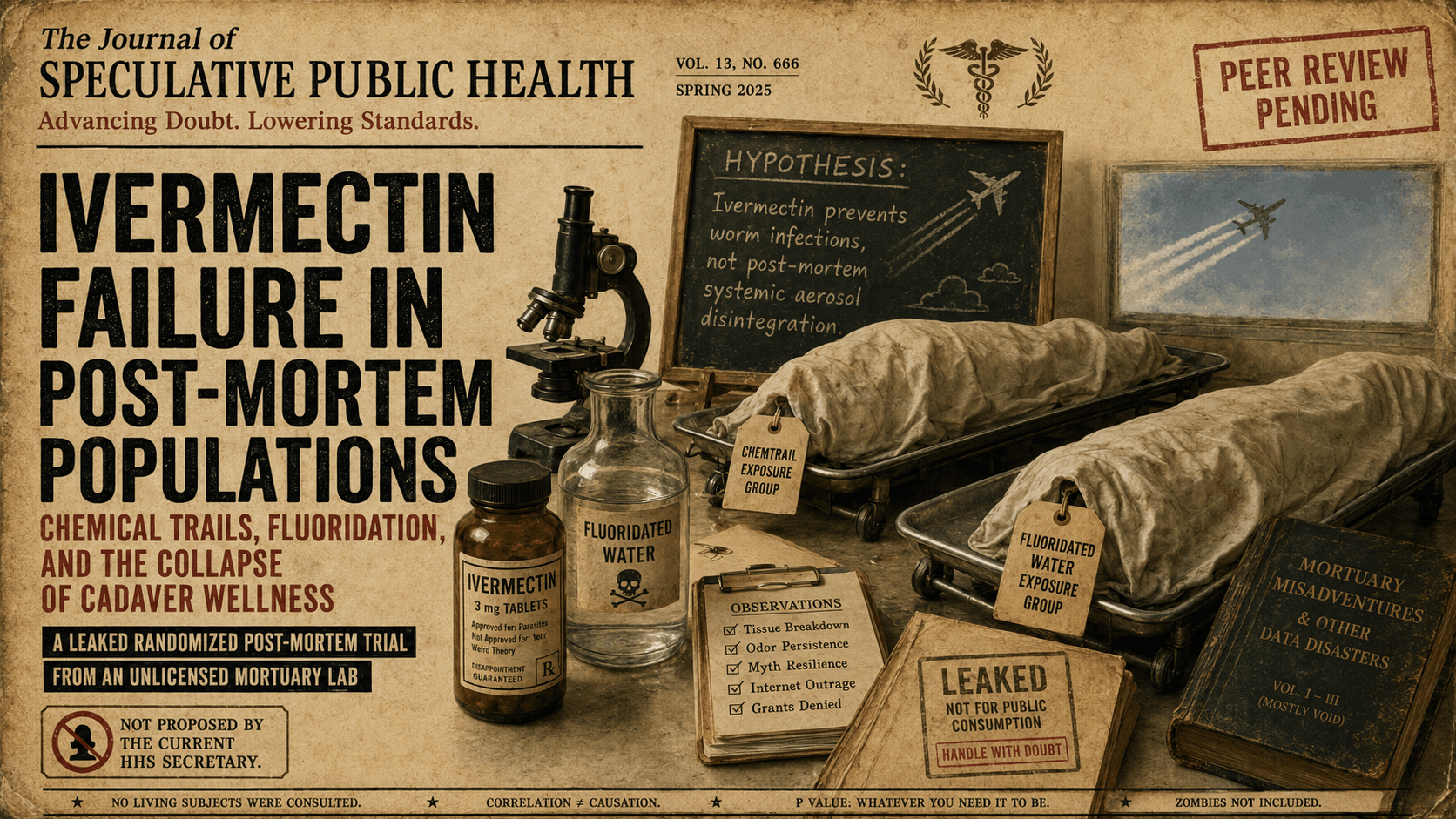
Ivermectin Failure in Post-Mortem Populations Exposed to Fluoridated Municipal Water and Persistent Atmospheric Chemical Trails
The authors wish to make this point exceptionally clear.
We have received no such recommendation from the Secretary, HHS, or any federal health agency.
We simply arrived independently at a treatment involving ivermectin, fluoride anxiety, atmospheric chemical trails, distrust of conventional medicine, and an insistence that contrary evidence strengthens the original hypothesis.
Any resemblance to contemporary American public-health discourse is therefore entirely, remarkably, almost suspiciously coincidental.
Background
Authorities in Chicago recently discovered dozens of human remains improperly stored at a funeral home, with reporting describing unrefrigerated conditions, decomposition, and pest infestation.
Conventional mortuary science has traditionally addressed these problems through refrigeration, embalming, sanitation, licensing, competent management, and a rudimentary awareness that dead bodies should not be stacked somewhere warm.
However, conventional mortuary science remains suspiciously dependent upon “experts.”
The Institute for Alternative Thanatology therefore investigated whether ivermectin, a medication famous for successfully treating several parasitic diseases and unsuccessfully becoming the answer to every unrelated question on the Internet, might offer a more freedom-oriented approach to cadaver preservation.
Researchers also investigated whether fluoridated water and persistent atmospheric chemical trails could explain any apparent treatment failure.
This explanatory framework was selected because “the basement was hot and full of corpses” lacked sufficient complexity to attract online engagement.
Methods
Fifty-six deceased subjects were retrospectively enrolled without consent on the grounds that the institutional review board had stopped returning our calls.
Subjects were assigned to one of four exposure categories:
- Ivermectin-positive / chemtrail-positive
- Ivermectin-positive / fluoride-positive
- Ivermectin-positive / fluoride-and-chemtrail-positive
- Control group accidentally refrigerated somewhere else
Actual ivermectin administration could not be verified in most cases. Researchers therefore employed the emerging technique of therapeutic inference, under which treatment is considered administered if somebody involved seemed like the sort of person who might have mentioned it.
Chemtrail exposure was quantified by looking upward.
Fluoride exposure was estimated according to municipal water records, ZIP code, and whether researchers could taste communism in the tap water.
Decomposition was assessed using the Modified Alternative Wellness Preservation Scale:
- Fresh
- Questionably fresh
- Unwell
- Constitutionally concerning
- Maggots
- Researchers blame the government
Statistical significance was established at p < whatever number appeared most persuasive.
Selected Findings
| Observation | Dr. Carrion’s Explanation | Peer Review Status |
|---|---|---|
| Bodies decomposed despite presumed ivermectin exposure | Fluoride apparently “deactivated the freedom molecules” | Shared 18,000 times |
| Maggot activity persisted | Parasites had probably developed ideological resistance | Podcast guest unavailable |
| Unrefrigerated remains deteriorated rapidly | Heat ruled out because summers existed before 2026 | Accepted by three Telegram channels |
| Refrigerated control remains decomposed more slowly | Suspicious correlation with Big Refrigeration | Under congressional investigation in our imagination |
| No measurable evidence of chemtrails was obtained | Evidence of an especially sophisticated chemtrail operation | Peer review successfully avoided |
“The ivermectin clearly worked. Unfortunately, the decomposition continued.”
— Dr. Mortimer D. Carrion, Principal Investigator and licensed distributor of alkaline burial socks
Results
At the conclusion of the observation period, 100% of unrefrigerated subjects remained deceased.
This result was unexpected.
Researchers initially hypothesized that ivermectin might restore what they termed cellular constitutional integrity, a process never observed, measured, defined, or believed to exist outside the Institute.
Instead, decomposition proceeded according to well-established biological processes with almost insulting consistency.
Temperature appeared strongly associated with decomposition. Investigators rejected this result because temperature is routinely measured using thermometers manufactured by corporations.
Maggot presence also showed a strong association with advanced decomposition. The research team cautioned against assuming causation, noting that maggots may simply prefer people who have consumed fluoridated water.
The strongest statistical relationship was observed between lack of refrigeration and things going extremely badly.
This relationship disappeared when researchers deleted that column.
Fluoride Interaction
Chemical analysis of Chicago municipal water was not performed because the laboratory required payment.
Researchers therefore relied on the established alternative-science principle that fluoride becomes more dangerous in proportion to how angrily somebody says the word “fluoride.”
Under the Fluoride-Ivermectin Antagonistic Preservation Hypothesis, fluoride ions enter post-mortem tissues, identify ivermectin molecules, and inform them that they are no longer authorized to prevent decomposition.
No molecular pathway for this phenomenon has been identified.
Researchers described this absence of evidence as “exactly what you would expect.”
Atmospheric Chemical Trail Exposure
The presence of aircraft over metropolitan Chicago provided compelling evidence that aircraft exist over metropolitan Chicago.
Several photographs showed white lines in the sky.
Researchers immediately classified these as persistent atmospheric cadaver destabilization agents, rejecting the older technical term “contrails” because it contains fewer syllables and therefore sounds less sinister.
Investigators theorized that aluminum, barium, strontium, fluoride, graphene, microchips, corn syrup, seed oils, and several substances remembered from a Facebook comment may have descended upon the funeral home.
No samples were collected. No instruments were used. No atmospheric scientists were consulted.
Accordingly, contamination could not be ruled out.
Discussion
The principal finding of this study is that ivermectin failed to prevent decomposition among dead human beings stored under deplorable conditions.
Under conventional scientific reasoning, this would suggest that ivermectin is not an embalming agent.
Such a conclusion would, however, prematurely exclude several considerably more interesting explanations.
- Ivermectin dosage may have been insufficient.
- Fluoride exposure may have neutralized its protective effects.
- Chemtrails may have accelerated decomposition.
- 5G telecommunications infrastructure may have altered the vibrational frequency of the basement.
- Government agencies may have manipulated local humidity to discredit alternative mortuary medicine.
- Refrigeration may work.
The research team considers the sixth hypothesis methodologically reckless.
Limitations
This study contains several limitations.
No randomized control group existed. No ivermectin treatment could be confirmed. No fluoride concentrations were measured. No chemtrail samples were obtained. No atmospheric analysis was conducted. No causal mechanism was identified. No competent statistician agreed to participate.
Researchers also concede that all subjects were dead before enrollment, which may have introduced a minor confounding variable.
Finally, prolonged unrefrigerated storage likely explains virtually every observation reported in this paper.
We consider this limitation unlikely to affect our conclusions.
Conclusion
Ivermectin did not successfully preserve human remains under conditions involving prolonged unrefrigerated storage, decomposition, vermin, and catastrophic administrative failure.
Rather than undermining alternative post-mortem therapeutics, these findings reveal an urgent need to investigate the suppressive effects of fluoridated water and atmospheric chemical trails upon ivermectin-mediated cadaver wellness.
Future studies should incorporate larger sample sizes, controlled chemtrail exposure, fluoride-free artisanal groundwater, and at least one refrigerator for comparison.
Until those trials are completed, practitioners are encouraged to follow established mortuary procedures instead of treating decomposition as a pharmacological puzzle.
The authors nevertheless caution against refrigeration.
We still do not know who manufactures the cold.
References
Associated Press. (2026, August 7). Remains of 56 people found improperly stored at Chicago funeral home. AP News. https://apnews.com/article/decomposing-bodies-funeral-home-chicago-00a478e6d48fadb43c8322caea83e76c
Carrion, M. D., & Rigor, C. (2026). Ivermectin-mediated stabilization of post-vital constitutional tissues: Preliminary observations from three road-killed opossums. Journal of Alternative Thanatology, 8(2), 14–31. Retracted after investigators discovered one opossum was sleeping.
Fluoridation Freedom Research Council. (2024). Municipal water and the progressive erosion of embalming liberty. Institute for Things We Already Believe.
Nimbus, C. T. (2025). Persistent aircraft condensation as a possible explanation for everything. International Review of Atmospheric Suspicion, 19(4), 1–847. Peer review declined on constitutional grounds.
Rigor, C. (2026). Refrigeration and the medical-industrial cold complex. Proceedings of the First Annual Conference on Thermostat Skepticism, 1, 3–7.