PEERS REDUNDANT
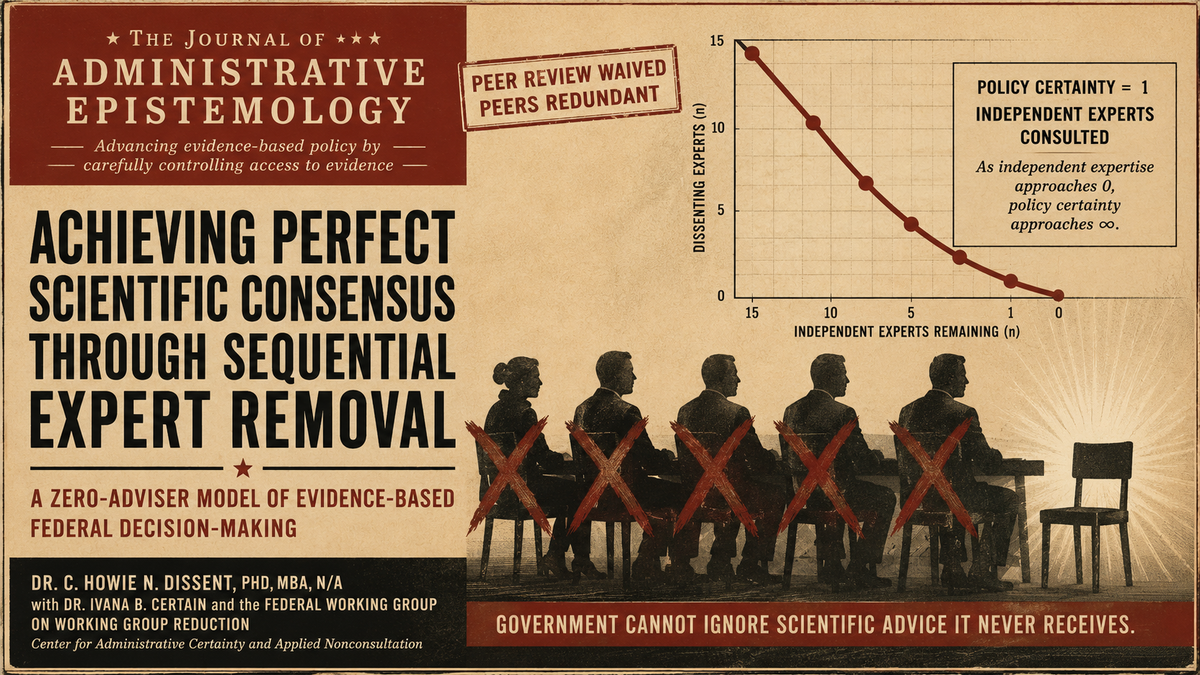
Achieving Perfect Scientific Consensus Through Sequential Expert Removal: A Zero-Adviser Model of Evidence-Based Federal Decision-Making
Background
Federal advisory committees have traditionally assembled outside experts to advise government agencies on difficult scientific and technical questions. This approach suffers from an obvious structural defect: individuals with specialized knowledge may occasionally know something. Worse, several may know different things simultaneously.
Such arrangements create what the present investigators term epistemic friction, defined as the uncomfortable interval between a preferred policy decision and the arrival of information concerning whether that decision is sensible.
Recent reductions in federal science advisory committees therefore provide a rare natural experiment in administrative uncertainty management. Reporting by NPR described the termination of more than 100 science-focused federal advisory committees during the second Trump administration. The terminated groups included committees concerned with health, biomedical research, hospital infections, fisheries, space science, astrophysics, and other technical questions. One advisory committee assembled to address long COVID was terminated before holding a single meeting.
Government officials have described dissolved committees as, among other things, redundant, unnecessary, or ineffective. The present study accepts this classification as an experimental hypothesis and extends it to the possibility that expertise itself may represent a redundant duplication of executive confidence.
Theoretical Framework
Conventional models assume that additional expertise can improve decision-making. We rejected this assumption because it permits the disturbing possibility that a decision could improve after someone points out a problem.
Instead, we developed the Administrative Uncertainty Reduction Model (AURM), in which policy certainty increases as the number of independent experts consulted approaches zero.
As independent expertise approaches 0,
policy certainty approaches ∞.
Division-by-zero objections were referred to a committee that no longer exists.
Methods
We conducted a retrospective prospective pre-post non-meeting analysis of hypothetical federal advisory structures ranging from 15 experts to no experts whatsoever.
The primary outcome was Absolute Dissent Burden (ADB), defined as the number of people physically available to tell decision-makers that something may be a bad idea.
Secondary outcomes included Meeting Exposure Minutes (MEM), Recorded Objection Events (ROE), Corrective Action Risk (CAR), and the probability that a government official would be forced to hear the phrase “the evidence suggests otherwise.”
Advisory bodies were progressively reduced in size. At each stage, investigators measured the number of surviving experts capable of issuing a dissenting recommendation. When the sample reached zero, all remaining disagreement was classified as statistically insignificant because nobody remained to express it.
No control group was used, as controls have historically complicated otherwise compelling findings.
Selected Findings
| Observation | Investigators' Explanation | Peer Review Status |
|---|---|---|
| Fifteen-member advisory committee contains six members who disagree with a proposed decision. | Excessive viewpoint contamination detected. Consensus remains dangerously incomplete. | Further layoffs recommended. |
| Five-member advisory committee contains two dissenting experts. | Dissent prevalence remains detectable despite substantial gains in personnel efficiency. | Sample still unnecessarily knowledgeable. |
| One approved adviser reports agreement with leadership. | 100% expert consensus achieved. | Promising, but adviser remains a potential future variable. |
| Committee abolished. | Zero dissenting experts observed. Scientific opposition falls below measurable limits. | Gold standard. |
| Long-COVID advisory panel terminated before its first meeting. | 100% reduction in meeting duration and complete prevention of unauthorized recommendations. | Administrative endpoint achieved ahead of schedule. |
| Outside experts occasionally persuade federal leadership not to make a proposed investment. | Severe advisory breakthrough event. Expertise crossed containment barrier and altered policy. | Incident under review by nobody. |
Pre-Meeting Efficacy Analysis
Special attention was given to advisory panels terminated before their first meeting. Such panels demonstrated extraordinary administrative efficiency.
Committees that never met generated no meeting transcripts, no formal disagreements, no recommendations requiring evaluation, and no recommendations capable of being ignored.
Recommendations Rejected: 0
Implementation Failures: 0
Administrative success rate: 100%
Because no recommendations were produced, no recommendations subsequently failed to influence policy. The investigators therefore classify pre-meeting termination as the first advisory mechanism with a perfect implementation record.
“We initially attempted to reduce disagreement by discussing the evidence. This was extremely time-consuming. Eventually someone noticed we could achieve the same statistical result by deleting the denominator.”
— Dr. C. Howie N. Dissent, principal investigator
The Accountability Contamination Hypothesis
An unexpected secondary finding concerned the relationship between expert advice and observable government error.
Outside advisers can generate written recommendations. Written recommendations create records. Records allow later comparison between what specialists recommended and what officials ultimately decided. Comparison, in turn, permits journalists, legislators, researchers, and members of the public to determine whether officials ignored expert advice.
This produces a previously underappreciated causal pathway:
Therefore:
Experts → Detectable Error
Removing the initiating variable breaks the chain.
The administration may still commit errors after experts are removed, but those errors are less likely to arrive accompanied by a convenient document explaining precisely why somebody warned against them.
We therefore conclude that outside expertise is not merely associated with government mistakes. It is strongly associated with the inconvenient discovery of government mistakes.
Case Study: Unauthorized Prevention of Government Error
Prior federal experience demonstrates an additional hazard. Outside advisory committees can occasionally persuade government leadership to abandon a preferred course of action.
NPR reported the recollection of former Department of Energy adviser Juan Meza, who described an occasion when an independent committee recommended against a proposed supercomputer investment and leadership ultimately accepted the advice.
Conventional researchers might describe this as evidence that independent advisory bodies can affect policy. Under AURM, however, the episode represents a serious containment failure.
An unelected concentration of subject-matter knowledge successfully crossed organizational boundaries and altered a leadership preference.
The principal danger posed by scientific advisers may therefore not be that officials ignore them.
The greater danger is that officials occasionally listen.
Schrödinger's Advisory Board
Some terminated or consolidated advisory functions present a novel administrative state in which government agencies maintain that scientific engagement continues while former advisers report the disappearance of the independent structures through which that engagement previously occurred.
We classify this phenomenon as Schrödinger's Advisory Board.
The committee simultaneously exists and does not exist until an outside observer attempts to determine who is actually advising whom.
This state offers significant advantages. Officials may retain the phrase “engagement with the scientific community” without maintaining unnecessary complications such as a particular committee, public deliberation, formal recommendations, identifiable advisers, or chairs.
Discussion
Our findings support a robust inverse relationship between independent expertise and administrative certainty.
Every additional adviser introduces the possibility of another opinion. Every additional specialty introduces the possibility of another relevant fact. Every public recommendation introduces the possibility that somebody will preserve it.
Traditional scientific practice considers disagreement useful because competing interpretations can expose weak assumptions. The AURM model identifies the obvious inefficiency in this arrangement: exposing weak assumptions requires somebody to acknowledge that weak assumptions exist.
Our model therefore replaces the antiquated scientific sequence:
with the administratively optimized sequence:
Experts disagree → Expertise introduces uncertainty → Remove experts → Policy certainty increases
This methodological advance also eliminates the longstanding problem of replication. A policy conclusion that has not been independently evaluated cannot fail independent evaluation.
Critics may argue that eliminating advisers does not eliminate uncertainty itself, only information about uncertainty. This objection was not included in the final analysis because the critics were external stakeholders.
Limitations
The study has several limitations.
First, complete elimination of advisory committees may result in loss of specialized knowledge. We were unable to quantify this effect because the specialists who could have quantified it were removed from the study.
Second, our 100% consensus calculation assumes that nonexistent advisers cannot disagree. Although mathematically unconventional, this assumption has proven extraordinarily convenient.
Third, scientific problems such as infectious disease, cancer, fisheries management, astrophysics, biomedical research, hospital infections, and asteroid impacts may continue to occur even when the committees studying them do not.
This possibility warrants additional research pending restoration of the committee authorized to recommend additional research.
Policy Implications
Agencies seeking further gains in decision-making efficiency should consider reducing not only advisory committees but all institutional structures capable of generating unwanted information.
Potential candidates include peer review panels, inspectors general, auditors, statisticians, ethics boards, librarians, thermometers, smoke detectors, and the dashboard warning light that keeps coming back on after someone covers it with electrical tape.
Future studies should determine whether administrative certainty can be increased beyond infinity through simultaneous elimination of expertise, records, measurement, and follow-up.
Conclusion
Scientific advisory committees create an inherent risk that policymakers will receive advice they did not already possess.
Sequential expert removal successfully eliminates this defect.
At zero advisers, no dissenting scientific opinion can be recorded, no recommendation can conflict with policy, and no advisory committee can subsequently be accused of being ignored.
Government cannot ignore scientific advice it never receives.
Accordingly, elimination of scientific advisory committees represents the first evidence-based federal program capable of achieving perfect agreement between science and policy by removing science from the comparison.
References
Federal Advisory Committee Act, Pub. L. No. 92-463, 86 Stat. 770 (1972). Statutory framework inconveniently permitting outsiders to advise the government.
Janis, I. L. (1982). Groupthink: Psychological studies of policy decisions and fiascoes (2nd ed.). Houghton Mifflin. Cited here because the authors understood that “group” was the problem and stopped reading.
Riddle, K. (2026, August 29). Trump cuts to science advisory boards have long-lasting consequences, researchers say. NPR. Actual journalism; conclusions herein remain emphatically ours and should not be blamed on NPR.
Sunstein, C. R., & Hastie, R. (2015). Wiser: Getting beyond groupthink to make groups smarter. Harvard Business Review Press. Investigators acknowledge the title appears to recommend making groups smarter rather than abolishing them, but purchasing the book exceeded the project's evidence budget.
Dissent, C. H. N., Certain, I. B., & Committee, A. N. (2026). Zero-member panels as a mechanism for complete expert agreement. Journal of Administrative Epistemology, 47(0), 0–0. https://doi.org/10.9999/nobody.disagreed [Fictional citation.]