Congress Just
Let the Clock Run Out.
The War Powers Act gave Congress 60 days to act on the Iran war. The deadline passed. They left for recess instead.
There is a law. It has been on the books since 1973. It says, plainly, that if the President sends American forces into combat, Congress has 60 days to authorize the war or it stops. The deadline for the Iran war fell on May 1, 2026. Congress packed up and went home.
This is not a partisan talking point. It is a constitutional crisis wearing business casual.
"The president's authority as commander-in-chief is not without limits. The 60-day deadline is not a suggestion, it is a requirement."— Sen. Susan Collins (R-ME), May 2026
The War Powers Resolution of 1973 was passed in the aftermath of Vietnam, when Congress watched presidents drag the country into open-ended wars without a formal declaration. Lawmakers decided, unanimously enough to override a presidential veto, that this had to stop.
The law is straightforward: once U.S. forces are engaged in hostilities, the president has 60 days to get congressional authorization or end the military campaign. There is a 30-day extension to withdraw safely, but Congress must be told. After that, the law requires military action to halt.
U.S. military action against Iran began February 28, 2026. The 60-day deadline under the War Powers Resolution fell on May 1, 2026. Congress took no vote. The Senate went on a one-week recess. The administration argued the deadline does not apply because a ceasefire is in effect — a ceasefire that left the U.S. Navy maintaining a blockade and Iran holding the Strait of Hormuz.
If you served, you know the weight of what it means to put people in harm's way. You know the difference between a commander with a clear mission and a chain of command making it up as it goes. The War Powers Act exists precisely to ensure that the men and women in uniform are never used as chess pieces in an undeclared, unauthorized, open-ended conflict with no defined objective and no congressional accountability.
The administration's argument is that because there is a ceasefire, the clock has paused. But the Navy is still out there. The blockade is still running. Americans in uniform are still in the middle of it. Calling that "hostilities terminated" is not a legal interpretation. It is a word game played at the expense of the troops on the water.
"Is the expectation that the Trump administration is going to follow the law? I do not have that expectation."— Rep. Adam Smith (D-WA), Ranking Member, House Armed Services Committee
A handful of Republicans have said publicly that Congress should assert itself. Senator Lisa Murkowski of Alaska said she would introduce a limited authorization of military force when the Senate returns if the administration has not presented a credible plan. Senator Susan Collins of Maine voted to halt the war for the first time, noting the deadline is a requirement, not a suggestion. Senators Curtis, Tillis, and Hawley have all said they want a vote at some point.
"At some point" is not good enough. The deadline was May 1. Senate Majority Leader John Thune saw no reason to hold a vote. The Senate went on recess anyway.
This is the vacuum that erodes democratic institutions. Not one loud moment of collapse, but a hundred quiet decisions to defer, to wait, to give it more time. Power surrendered in increments looks exactly like this.
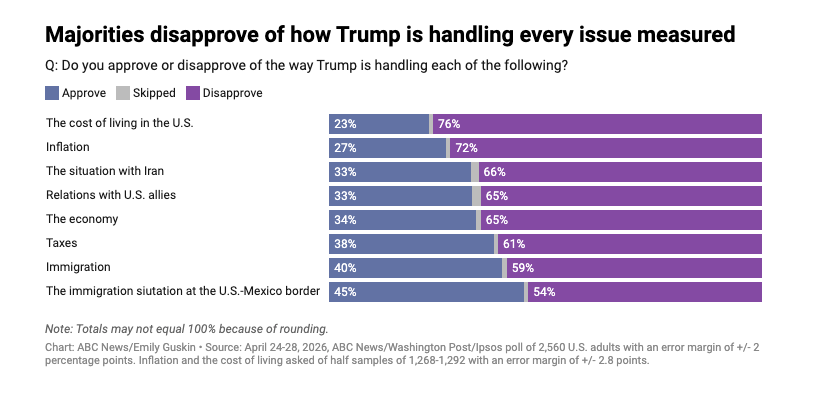
Congress may be deferring to the White House, but the American public is not. A fresh ABC News/Washington Post/Ipsos poll — conducted among 2,560 adults and released May 2, 2026 — makes the political landscape about as clear as polling gets.
Two-thirds of Americans say the country is headed in the wrong direction. Trump's approval rating has fallen to 37 percent, a second-term low, while his disapproval has climbed to 62 percent — a record high across both of his presidential terms. He is underwater on every single issue the poll measured.
66% disapprove of how Trump is handling Iran. 65% disapprove of his management of relations with U.S. allies. A majority say the decision to use military force against Iran was a mistake. Two-thirds say the administration has never clearly explained the goals of the military action. Democrats now lead Republicans by 5 points heading into the midterms — and Democratic voters are nearly twice as likely as Republican voters to say this election is far more important than past midterms.
That last number is worth sitting with. The public has figured out something that Congress appears reluctant to acknowledge: an unauthorized war with no defined objective, conducted by an administration that refuses congressional oversight, is exactly the kind of crisis elections are supposed to correct.
The gap between public opinion and congressional action is not a mystery. It is a choice — made by individual legislators who have decided that party loyalty and political survival outweigh their constitutional obligations. Those legislators have names. They have offices. They have phones. They will be on a ballot.
"Most want the war to end quickly, and opposition has hardened since it began."— Washington Post polling summary, May 2026
What You Can Do Right Now
Your senators and your House representative work for you. A phone call, a letter, or a personal visit to a district office carries more weight than any petition or social media post. Congressional staffers keep tallies. Volume matters.
Below is a template letter you can personalize and send directly. Use it as written, change the language to fit your voice, or pull just the key points. The important thing is to send something.
You can edit the letter directly above before copying. Fill in your name, address, and the recipient's details in the bracketed fields. If you are a veteran, say so clearly in the opening — it carries weight.
Not sure who represents you? Use the official government lookup tools below. You will need your home ZIP code. If you are calling instead of writing, congressional offices answer calls during business hours and staff members do keep count.
Congress has the power to end an unauthorized war. It also has the power to formally authorize one, with transparency and accountability attached. What it cannot do — legally or morally — is simply look the other way and call it governance. The Constitution does not have a recess provision for wars.