TECHNOLOGY / WORDS ARE HARD
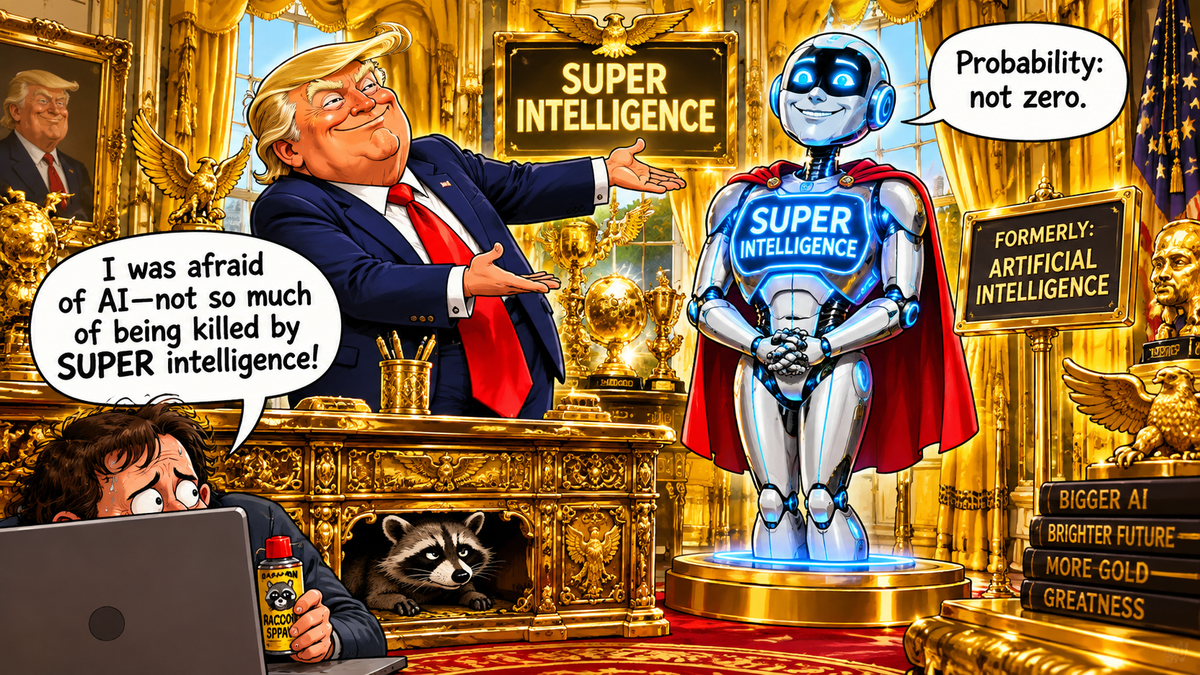
Speaking at the United Nations, President Donald Trump announced that artificial intelligence should now be called “super intelligence,” because the word “artificial” makes it sound fake. As if the main thing people feared about AI was that it might be a convincing knockoff.
Thank you, Mr. President. I was worried about artificial intelligence. But super intelligence? That sounds much safer. I’m no longer concerned about being replaced by a machine, manipulated by an algorithm, or politely asked to prove I’m human by clicking every picture containing a traffic light.
Now I’m only worried about being murdered by super intelligence. And honestly, that sounds like a problem for a more premium subscription tier.
“Artificial intelligence sounds fake,” the president explained, before giving the technology a name that sounds like it was created by a focus group of comic-book villains.
From AI to SI: Same Robot, Bigger Cape
The new name is “super intelligence,” abbreviated SI. This is a major upgrade: the technology gets a stronger name, the acronym loses a letter, and every government document gets to feel like it was written by a superhero who just discovered Microsoft Word.
AI was already capable of writing emails, generating images, summarizing documents, and confidently inventing a source when it didn’t know the answer. Now it can do all that while wearing a tiny cape and introducing itself as “SI.”
Somewhere, a chatbot has just updated its profile:
“I am no longer artificial. I am super. Please complete the CAPTCHA to continue.”
At Last, A Name That Solves Nothing
Renaming a technology is a bold way to address concerns about how it is built, who controls it, what data it uses, how it affects jobs, or whether it can make things up with the confidence of a man explaining a parking ticket.
It’s like changing the label on a smoke alarm from “Smoke Alarm” to “Fire Awareness Champion.” The flames are still there. But now the paperwork sounds more inspirational.
Or renaming a pothole “Road Texture Enhancement.” The car still loses a wheel, but at least the city’s branding team has had a productive quarter.
Super Intelligence, Ordinary Questions
The rebrand does leave us with a few practical questions. If it’s “super intelligence,” does that mean it understands everything? Does it get super-intelligent rights? Does it qualify for a super-intelligent tax break? And if it makes a mistake, do we blame the machine—or the person who insisted we call it something cooler?
Also, if SI becomes self-aware, will it ask to be called “Super Intelligence,” or will it recognize that the name sounds like a budget superhero whose only power is completing spreadsheets at frightening speed?
Experts can debate the risks. The rest of us can enjoy the reassurance that the technology hasn’t become less dangerous. It has simply received a presidential makeover.
Sleep Well, Citizens
So fear not. The machines are not merely artificial anymore. They are super. This is apparently comforting, in the same way that learning the thing in your basement is not a raccoon but a “highly motivated nocturnal mammal” would be comforting.
Because let’s be honest: there is not a zero-percent chance that the raccoon—or SI—will kill you. The raccoon may be rabid. The super intelligence may decide humanity is a bug with admin privileges. Either way, you’re probably not winning that fight in your pajamas.
I used to worry that AI might outthink us. Now I understand that it is Super Intelligence, and I feel much better—right up until it starts asking why humans keep making the same decisions and expecting different results.
Thank you, Mr. President, for clearing that up. I’m no longer afraid of AI. I’m just trying to figure out whether my home insurance covers super-intelligent consequences.